
Authentic Italian Home Cooking, Every Day


Tokyo is home to a vast number of Italian eateries, ranging from high-end restaurants to trattorias, pizzerias, and specialty pasta shops. This began in the 1960s and 1970s, when awareness of Italian cuisine in Tokyo began to grow through overseas travel, television, and magazines. At that time, however, there were only a few Italian dishes most Japanese diners were familiar with, like spaghetti, macaroni, and pizza.
This started to change in the 1980s, when growing numbers of young Japanese chefs traveled to Italy for training, returning home having mastered its various local cuisines firsthand. Around this time, restaurants serving authentic Italian dishes gradually began popping up in Tokyo. This accelerated from the late 1980s into the 1990s with the rise of the "Itameshi" (Italian dining) boom. Imports of Italian products such as wine increased, and the distinctive regional cuisines from various parts of Italy began to attract significant attention.
From Italy to Tokyo
One of the pioneers who helped shape Tokyo’s authentic Italian scene is Chef Tsutomu Ochiai of “LA BETTOLA da Ochiai,” located in a quiet neighborhood in Tokyo’s Ginza district—a hub for cutting-edge dining. The restaurant has been beloved for over a quarter-century, guided by the philosophy of “Italian food you’ll never tire of, even if you eat it every day.” When it opened in 1997, however, down-to-earth, unpretentious Italian trattorias were uncommon in Tokyo, as the scene was dominated by fancy establishments with elevated prices. LA BETTOLA da Ochiai—where diners could casually enjoy Italian home-style cooking—came to have a major impact on the popularization of authentic Italian cuisine in Japan.
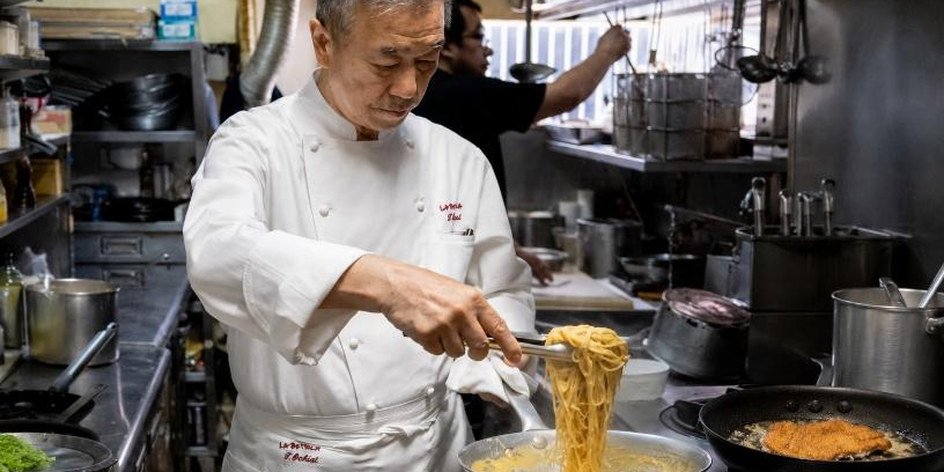
“Bettola” is an Italian word meaning “tavern” or “diner.” In other words, a place offering everyday comfort food. For dinner, LA BETTOLA da Ochiai offers a set menu of appetizers, pastas, and main courses that guests can mix and match into their own multi-course meals. Regardless of your combination, the rate is flat, reflective of Ochiai san’s longstanding philosophy.
“I don’t want to make customers feel bad by charging extra,” said Ochiai san, a sentiment that has earned the restaurant loyal support in Tokyo, a city where trends change rapidly.
“Around 1980, when I went to Italy, there was no one in Japan teaching Italian cuisine,” said Ochiai san. “That’s why I went to Italy to study it. Compared to those days, Italian cuisine has changed quite a bit but even so, what Italians eat at home is still pasta with tomato sauce, which hasn’t changed a bit. Except for perhaps on a special occasion, they don’t really go to restaurants for fusion-style dishes, that’s for tourists.” Laughing, Ochiai san continued: “Italians are stubborn, so they think, ‘Why do we have to change a dish that’s already so delicious?’”
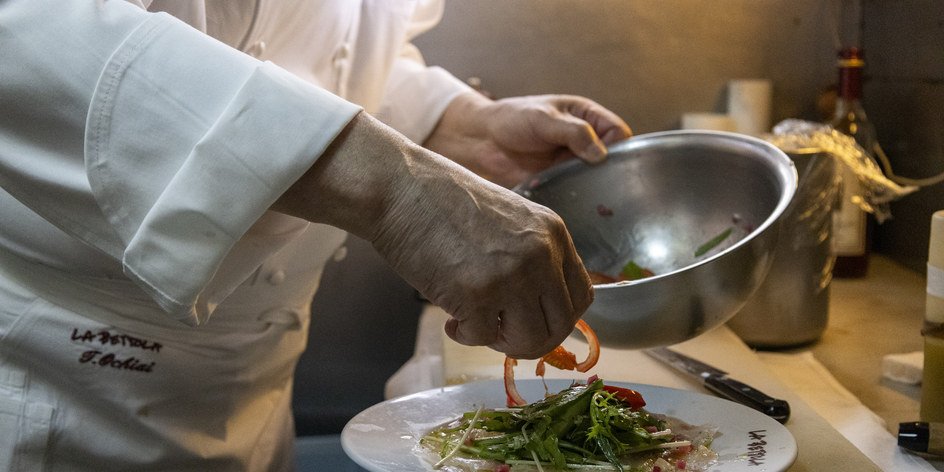
Ochiai san was 31 when his culinary studies in Italy began and his story sometimes sounds more akin to that of a European starving artist than a budding Japanese Italian chef. He trained at more than 18 restaurants, moving from Rome to Naples, Sicily, Florence, Bologna and elsewhere, oftentimes arriving at specific establishments based on tips and smilingly pantomiming his way into work-for-food arrangements. It may not have been glamorous, but his learning curve was steep.
“I realized that you never get tired of Italian food, even if you eat it every day,” said Ochiai san. “That was a real eye-opener.” It was during this time that Ochiai san began thinking of his own Italian restaurant in Japan, already envisioning it as a casual, home-style place. But that was to be further in the future. Upon returning to Tokyo, he was put in charge of “Granata,” a restaurant in Akasaka. It was opened to coincide with his return by the owner of “Tops,” Ochiai san’s employer before Italy, who had encouraged him to train there.
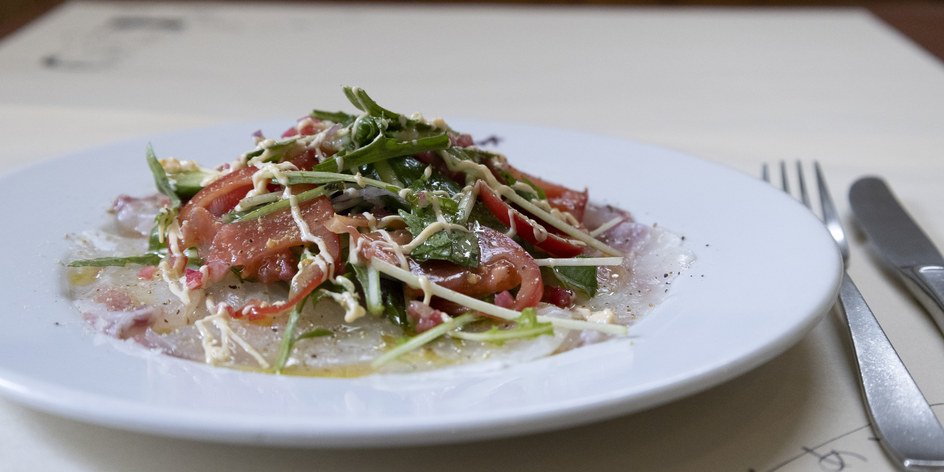
“Fish Carpaccio” from the Granata Era
It was 1982 when Ochiai san became Granata’s head chef and initially, the 100-seat restaurant struggled to attract customers. But under Ochiai san’s leadership it eventually gained widespread acclaim through word-of-mouth, catalysed by visits from Italian Government Tourist Board officials. Then came the famous “bubble economy” era of the late 1980s and early 1990s, characterized by inflated asset prices and conspicuous consumption. During this trendy time, Japanese consumers became captivated by the sophisticated fashion, cars, and music of Italian culture. Coupled with a nationwide craze for gourmet dining, Italian cuisine garnered immense attention that until that time had been primarily reserved for French cooking.
The arrival of stylish, accessible Italian food changed Tokyo’s dining landscape, with novel desserts like tiramisu and panna cotta becoming massive hits. Under Chef Ochiai’s tutelage, Granata soon emerged as a trendy social hotspot, becoming an establishment that was constantly packed and notoriously difficult to book.
"When we first opened, we served beef carpaccio—a staple of Italian “ristorante” cuisine,” said Ochiai san. “But even when we thinly sliced the raw beef and sprinkled cheese over it, nobody would eat it. People would even tell me, 'Don't cut corners; grill it. Serve a proper dish.'”
Then one day, Ochiai san visited the kitchen of a next-door, affiliated Japanese restaurant and came across a fillet of red sea bream. He then decided to try and make a fish carpaccio.
“I seasoned the thinly sliced sashimi-grade bream with salt and pepper,” said Ochiai san. “I then squeezed on some lemon juice, drizzled it with olive oil, and topped it with a salad—and it turned out to be surprisingly delicious. From then on, I featured both meat and fish carpaccio options on the menu, but eventually simply offered the fish version as that is what our diners wanted.”
In this way, Ochiai san broke new ground in the Tokyo Italian culinary scene by creating new Italian dishes inspired by traditionally-Japanese ingredients.
LA BETTOLA Opens its Doors
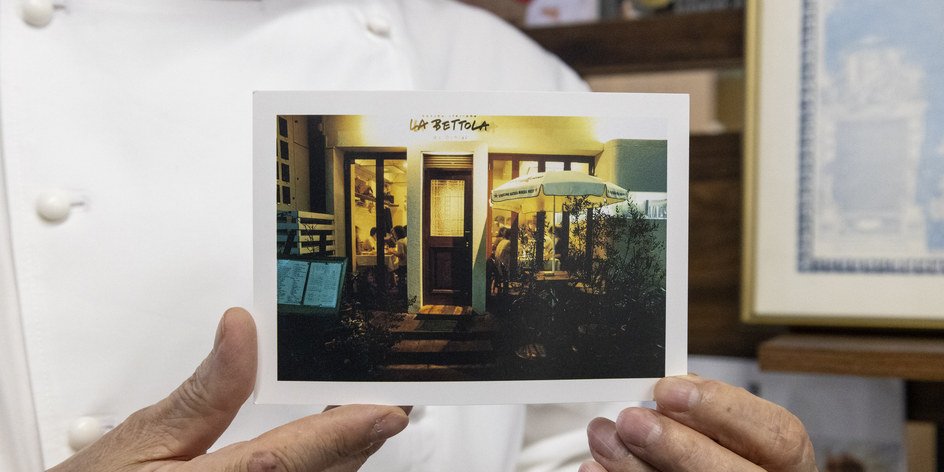
After 14 years at Granata, Ochiai san left the restaurant in November 1996. The following year, he opened his restaurant in a quiet corner of Ginza. This casual “bettola” was the realization of his vision that began percolating in the early 1980s while restaurant-hopping across Italy: a diner serving accessible, Italian home-style cuisine.
“A “ristorante” has an owner who can use as many high-quality ingredients as they want. There’s a staff to provide service, the interior is elegant, and the location is prime,” said Ochiai san. “That’s precisely why it can call itself a “ristorante.” But for a place I can run myself, I couldn’t hire that many people, nor could I spend that much money on the interior or furnishings. So I decided to make a 180-degree turn with LA BETTOLA.”
Ochiai san explained that in the 1990s when he was working at Granata, a set menu typically cost 20,000 yen, with the cheapest option around 12,000 yen, a considerable sum for a single meal. But despite the high prices, the restaurant was always packed.
“I found myself wondering if that was really okay,” said Ochiai san. “I had this feeling that Italian cuisine in Tokyo was starting to veer off course. There are plenty of high-end restaurants in Italy too, but I was worried that if things continued in this almost exclusively fancy way, young people in Japan would end up overlooking authentic Italian cuisine without ever getting to know it.”
Ochiai san wanted to create a place in Ginza— a district with a high-end connotation—where anyone could enjoy themselves without worrying about their wallet. He therefore devised a flat-rate, set menu where diners could choose among several options for appetizers, pasta, and main courses. At the time, dinner was priced at 3,800 yen (excluding tax), allowing two people to enjoy a meal for under 10,000 yen.
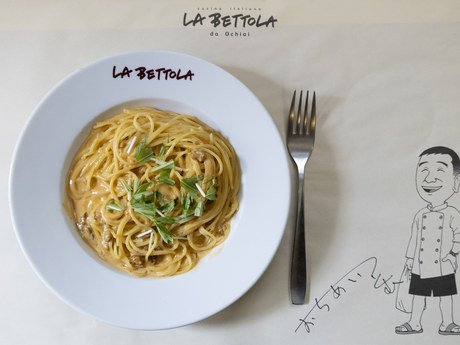
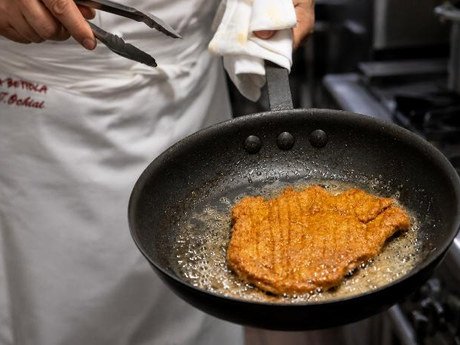
LA BETTOLA’s first month after opening was slow, but then an acquaintance from a nearby publishing house began bringing various colleagues in, turning the restaurant into something resembling an employee cafeteria. As awareness spread, the restaurant began appearing in magazines. This marked the turning point that transformed it into a thriving establishment. Although LA BETTOLA’s inspiration was authentic homestyle cooking such as pasta with tomato sauce, Ochiai san carried on some of the popular dishes he pioneered at Granata, such as “Today’s Catch Carpaccio” (the sea bream appetizer created to suit Tokyo diners’ tastes), “Cream Pasta with Fresh Sea Urchin,” and “Pork Cutlet with Tomato & Arugula Salad.” And for his seafood and other supplies, in the years he led the kitchen, he continued to ride his bicycle to the former Tsukiji Market (whose functions have since moved to Toyosu Market) every morning to source fresh, affordable ingredients.
Everyday Italian Cuisine Continues
When you step through the doors of LA BETTOLA da Ochiai, you encounter more than just the cuisine. You find the living legacy of Tsutomu Ochiai—a chef whose sincere dedication has expanded Tokyo’s culinary horizons for more than three decades. Rather than competing on opulence or rarity, Ochiai san set off to make Italian food a beloved part of everyday life in Japan’s capital. Although Ochiai san stepped down as head chef of LA BETTOLA 10 years ago, his son Tsuyoshi san, the general manager, and Executive Chef Naoki Narita continue to run the restaurant with the same vibrant energy.
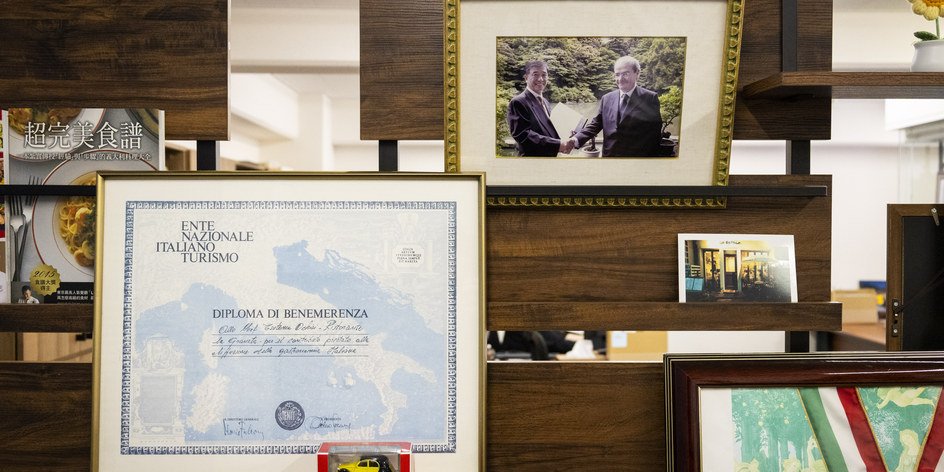
"It brings me such joy when people come back again and again," said Ochiai san. This desire to build a scene, a dedicated patronage around authentic, delicious cuisine is a sentiment that has come to underpin the richness of Tokyo’s food culture.
Tokyo offers many other cuisines and a rich food culture — please explore them with GO TOKYO Gourmet.
LA BETTOLA da Ochiai Ginza Main Store
Tsutomu Ochiai
Born in Tokyo in 1947, Tsutomu Ochiai joined the Hotel New Otani at age 19 and transferred to “Tops” in 1972. He then traveled to Italy, where he honed his skills at more than 18 restaurants in various cities, including Rome, Naples, and Florence, from 1978 to 1981. Upon his return to Japan, he became head chef at “Granata” in Akasaka in 1982. In 1997, he opened “LA BETTOLA da Ochiai” in Ginza, making a significant contribution to the popularization of Italian cuisine in Japan. He served as chairman of the Japan Italian Cuisine Association for 10 years and currently serves as its senior advisor. He has received the Order of the Star of Italian Solidarity (Cavaliere), the Commissioner of the Agency for Cultural Affairs Award, and the Medal with Yellow Ribbon, among other honors.
Address
1-21-2 Ginza, Chuo City, Tokyo 104-0061
http://www.la-bettola.co.jp/
To learn more about
you can press “copy” and paste on search engine