
A New Sensory World of Tokyo Dining


A meal is at its most satisfying when it engages more than the palate. The way a dish looks, its aroma, the feel of that first bite on the tongue and the resistance as you chew — when all five senses come into play, the pleasure deepens. And as many of us know from experience, the surroundings matter just as much: the vessels a dish is served in, the way a room is arranged, the whole setting around the table shapes how a meal is experienced. Lately, a number of restaurants have opened across Tokyo that take this idea even further. By pairing cuisine with digital art — light and sound woven together, with imagery depicted onto the tableware and the table itself — they turn a meal into something extraordinary, an unforgettable experience unfolding within a dreamlike, immersive world.
On a quiet backstreet just steps away from the bright avenues of Ginza, a new dining experience centered on fine cuisine and state-of-the-art technology is waiting for the select few. Experience flower petals falling as seasonal delicacies are placed before you, or sashimi dishes interrupting an ocean current, with fish swimming up to your dish and butterflies taking flight from blooming lotuses.
MoonFlower Sagaya Ginza, Art by teamLab (hereafter “MoonFlower Sagaya Ginza”) is one of several new Tokyo dining experiences that offer meals along with art and immersive presentations. But unlike the American and European tradition of “Dinner Theatre,” the entertainment provided by these culinary projects is inseparable from the cuisine itself, tying into themes of seasonality, Japanese history and culture.
Pairing seasonal courses with interactive artworks, MoonFlower Sagaya Ginza is a special collaboration between Ginza’s Sagaya restaurant and the famous international artist collective teamLab, known for its stunning light installations throughout Japan and the world. The MoonFlower Sagaya Ginza experience takes place in a dedicated, eight-seat dining room within Sagaya, equipped with discreetly installed projectors, cameras and speakers that turn the walls, table and entire room into an interactive art experience. The room seats only eight because the artworks respond to individual hand and plate movements; with a larger party those responses would scatter, and the sense of being inside a single unfolding world would be diluted. The result is a novel form of dining fusing 21st Century Tokyo innovation with Japanese cuisine.
Once a party is seated, either consisting of separate, combined reservations or a private booking, plates are placed before each diner and the digital art performance begins, with foliage growing from the dishes before spreading along the table and walls. As the meal progresses, rivers flow, fish, birds, and butterflies travel through the water and air and the diners join an elegant world tied to the courses and season.
Where Cuisine Meets Art
From teamLab’s 2001 founding in Tokyo, it has mainly focused on large-scale installations capable of providing immersive experiences to thousands. MoonFlower Sagaya Ginza is different. It provides a slow, intimate experience shared with a select few over a two to two and a half hour meal. As the visuals move in time with the arrival of each course, the plate and cuisine merge with the artworks and sounds of the room, creating a holistic, slowly-unfolding sensory adventure.
As a technological addition to Tokyo’s Japanese Cuisine tradition, the artworks are tied to both the season and, remarkably, to guest behavior. AI mapping within embedded cameras responds to the movements of the guests’ hands and plates, altering the artworks in real time and ensuring that one will never have the same MoonFlower Sagaya Ginza experience twice.
Staging & Sense
“There are scenes of rivers and waterfalls,” said MoonFlower Sagaya Ginza head chef Haruhisa Tadano, “and in those moments as you focus on the sounds and artworks, there is a kind of chilliness you can feel. But the room temperature hasn’t changed… I don’t think you could experience this without the visuals.”
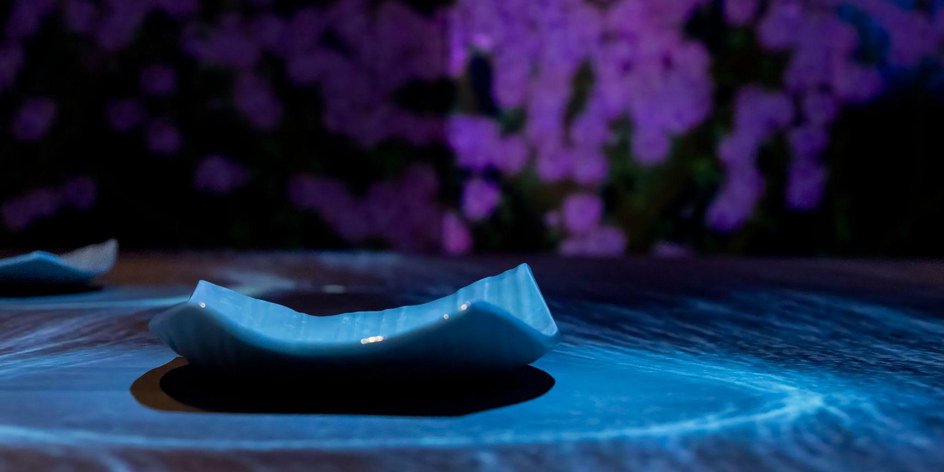
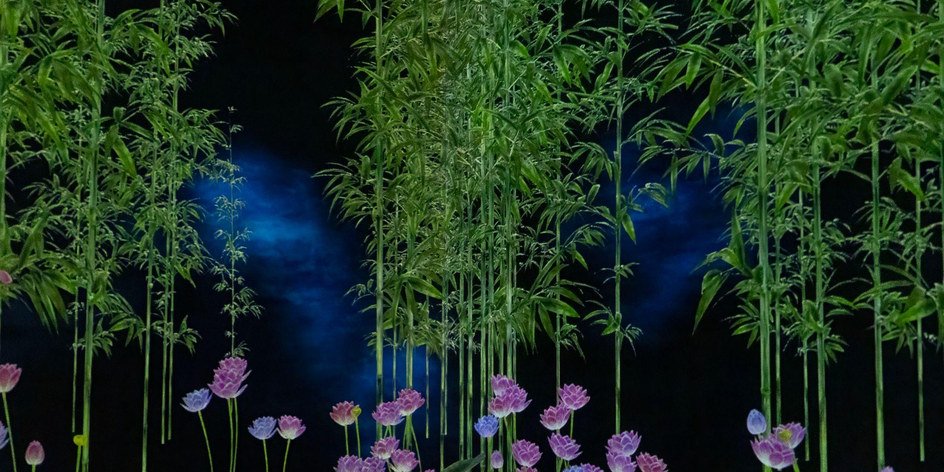
Most have experienced the sensation of movement while on a stationary train simply due to an adjacent train’s departure. MoonFlower Sagaya Ginza creates this phenomenon as a shared experience among each of its small dining cohorts. Flower stalks stretching across the walls and swaying with the breeze lead to the sensation of wind, a butterfly landing on your plate is the crisp air of early spring, and when a river of light depicted flowing across the table is obstructed before channeling around a dish, you may not be sure whether you first heard the soundtrack of gurgling water or if this already emerged as a murmur of the mind. teamLab may be best known for its visuals, but at MoonFlower Sagaya Ginza no single sensation - taste, sight or sound - takes center stage. What stays with you is the way they overlap and how your own senses fill in what remains unsaid, so that the room can feel cool, or the air can feel like early spring, when in fact nothing in the actual environment has changed at all.
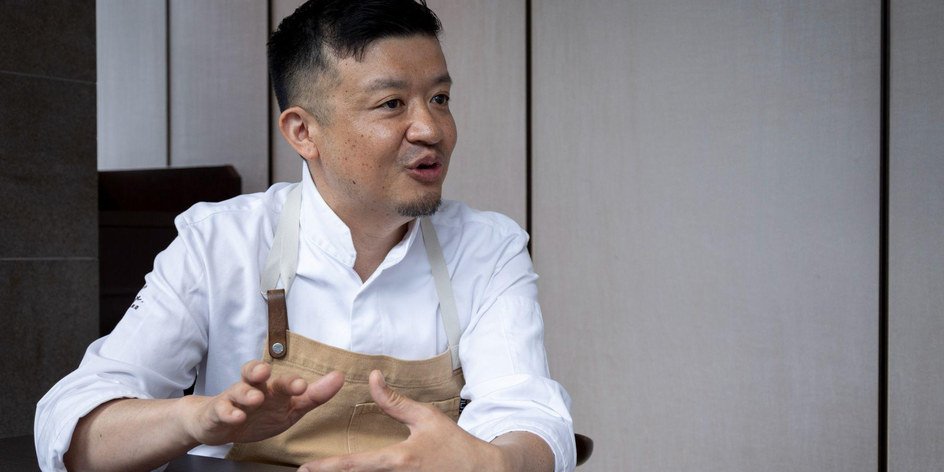
MoonFlower Sagaya Ginza, Art by teamLab head chef Haruhisa Tadano
The “Tsukihana” Course
Every dish here is built to move in step with the artworks, and that is why only one omakase, or chef’s selection, meal is offered - the “Tsukihana Course” (“tsukihana” literally meaning “moon, flower” in Japanese). Adhering to one multi-course meal allows the kitchen to time each of the nine dishes to the scene unfolding on the table, and lets the season dictate what appears. It begins with an appetizer of seasonal ingredients, followed by an intermediate course to cleanse the palate. The main dish is Saga beef, and the concluding dish is a seasonal dessert. While the Saga beef is served year-round, the other items on the menu - including the seafood dishes - change monthly according to what is most in season. In spring, savor grilled, sweet sea bream with wild mountain vegetables; in summer, charcoal-grilled conger eel; in fall, straw-grilled bonito caught while migrating south; and in winter, a cold-water yellowtail appetizer with water chestnuts and savory spinach.
Wine and sake pairings are available on request, selected to complement both the cuisine and the artworks. As guests now arrive from across the world, accommodating allergies and dietary restrictions has become part of how the course is planned: guests are encouraged to let the restaurant know well in advance so the menu can be adjusted to the best of the member’s ability.
A State of Flow Born of Trial & Error
But the state of flow that MoonFlower Sagaya Ginza guests get to experience was born out of a painstaking process of trial and error, as well as careful decisions regarding vessels, plating and timing.
Tadano spoke of many challenges regarding fusing digital art with cuisine when preparing for MoonFlower Sagaya Ginza’s opening in 2017. Some of these were strictly technical, a process of training the AI systems to recognize particular movements and respond appropriately. Other aspects of the staging made him rethink his own long-standing ideas of how dishes must be presented. That digital art and fine dining can be merged in such a way owes something to Tokyo itself: few cities place a kitchen working in a centuries-old culinary tradition close enough to cutting-edge studios so both can spend years refining a single evening together.
“At first, driven by a chef’s ego, I wanted the food to be the star above all else,” said Tadano, adding that he was particularly worried about the dim setting taking away from the meal’s presentation. “But when I saw the beautiful space that had been created—where guests enjoy visuals and sounds, and sometimes even touch the tables or walls—I realized that engaging all five senses creates a truly unique dining experience.”
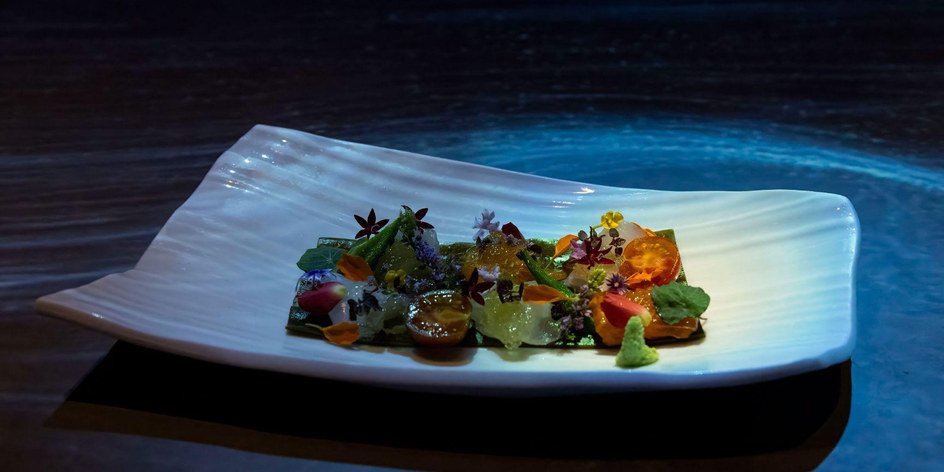
Assorted Morning-Caught Seafood with lightly pickled jelly, served in July. The sashimi -including squid, salmon, and flounder - is accented with fresh vegetables and edible flowers.
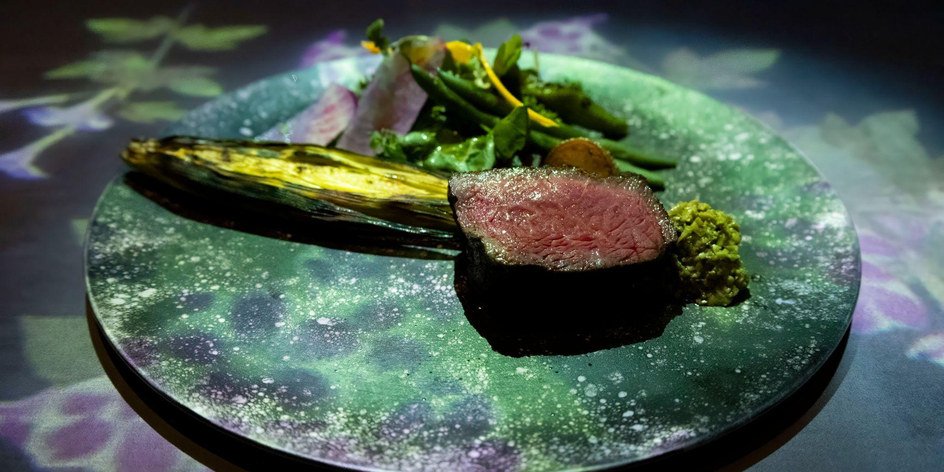
The centerpiece of the course is the specialty “Saga Beef Châteaubriand Steak with Pesticide-Free Salad.” A tapenade sauce made with a blend of fresh Cambodian pepper and olives brings out the rich umami flavor of the Saga beef.
This thought about the interplay of cuisine, artworks and soundscape also influenced the tableware selection. Sagaya’s meat is a famous line of Grade A5 Japanese Black Wagyu Beef from its namesake, Kyushu’s Saga Prefecture. True to form, MoonFlower Sagaya Ginza cutlery is exclusively Arita ware, a traditional porcelain made in Arita Town, Saga Prefecture with a four century history. The dishes are beautiful, yet simple, and often custom-designed in consultation with the pottery studios so they can interact with the artworks, effectively “communicating” with the AI system.
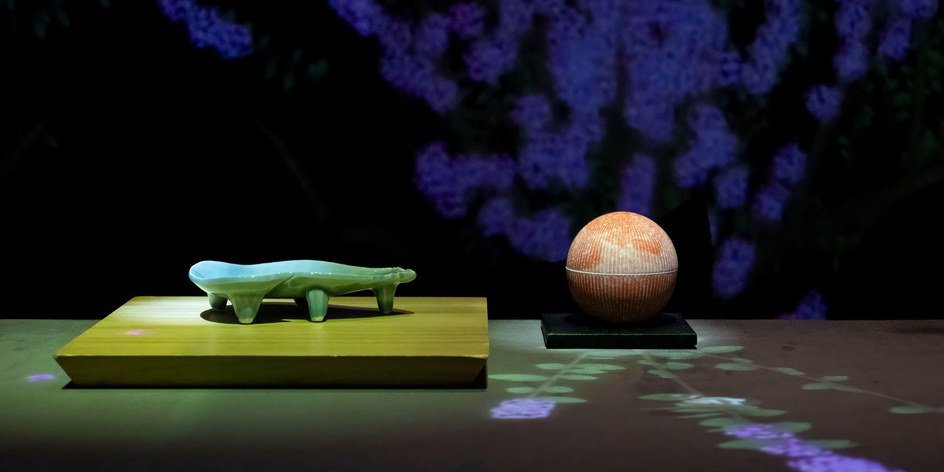
“For example, if we want to create a scene where a fish jumps out,” said Tadano, “we’ll have the studio paint a fish on the plate, commissioning the piece during the program planning stage. Since the system is designed so that AI recognizes the plate and triggers the visuals, no other plate will work. Going from conception of the program to completion can take quite a long time.”
Observant guests will also notice that the names of the potters who created each piece are listed on the course menu, offering another way to appreciate the experience.
A New Era of Dining in Tokyo
About 90% of MoonFlower Sagaya Ginza’s guests are international visitors, including from Europe, the Americas, Asia, Africa and the Middle East. Tokyo is already a destination for most of these visitors, drawn to its long-established shops, brightly lit thoroughfares, Kabuki theater and renowned sushi, French, and tempura restaurants. Immersive dining experiences like MoonFlower Sagaya Ginza are often the next step for sophisticated travelers who have already experienced fine dining in Tokyo.
“Our guests have usually seen a great deal already,” said Tadano. “And yet when I see someone clearly enjoying our presentation or letting out a gasp of surprise, it makes me happy to realize that we’re providing a truly one-of-a-kind experience. This is probably the only place where you can dine surrounded by sunflowers in full bloom at night.”
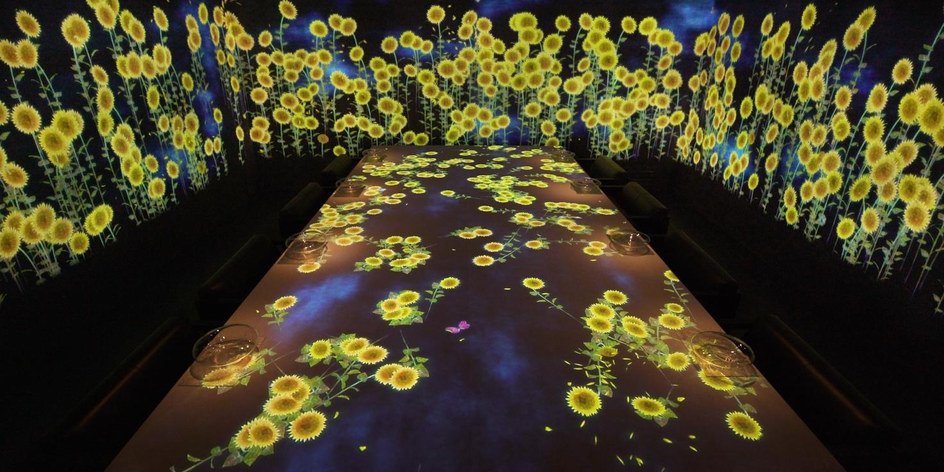
Despite the novelty, MoonFlower Sagaya Ginza and other interactive dining experiences are not something wholly new and removed, but rather the modern evolution of a dining culture that has emphasized seasonality for centuries, along with presentations or live entertainment calibrated to complement the dishes. In other words, such dining may incorporate Tokyo-born cutting edge technology, but the artworks rest on an ancient foundation. Experiences like this belong to Tokyo’s food culture rather than to any single neighborhood — a city that continually takes in what’s new while remaining anchored to ancient ideas of season and time. Tokyo’s interactive dining like MoonFlower Sagaya Ginza is carrying these established customs into a new era.
Tokyo offers many other cuisines and a rich food culture — please explore them with GO TOKYO Gourmet.
MoonFlower Sagaya Ginza, Art by teamLab
Haruhisa Tadano
Executive Chef
Born in Saitama Prefecture in 1978. After working at hotels and restaurants in Tokyo, he moved to Italy to train. On his return to Japan he served as sous chef at a restaurant in Hotel Nikko Tokyo before taking up his current post. Drawing on Italian and French technique, he handles each ingredient with care to draw out its natural flavor.
Address
PUZZLE Ginza 6F, 2-5-19 Ginza, Chuo City, Tokyo 104-0061
https://moonflower-sagaya.com/en/
To learn more about
you can press “copy” and paste on search engine