From Edo to Today: The Story of Oyakodon


In the 19th Century: From Edo to Meiji
In the 19th century, as the Edo era was eclipsed by the Meiji period (which ran from the late 1860s to 1912), Tokyo became one of the world’s greatest metropolises, if not yet an international one. With a population of over one million, foodstuffs and delicacies flowed from across Japan’s land and sea into the city. The neighborhood of Nihonbashi, just east of today’s Tokyo Station, was home to a fish market, and many shops opened in this area that remain today. It was also a center of entertainment culture, including kabuki and puppet theater. Against the backdrop of this fast-paced environment, dishes that were quick, delicious, and easy to eat flourished.
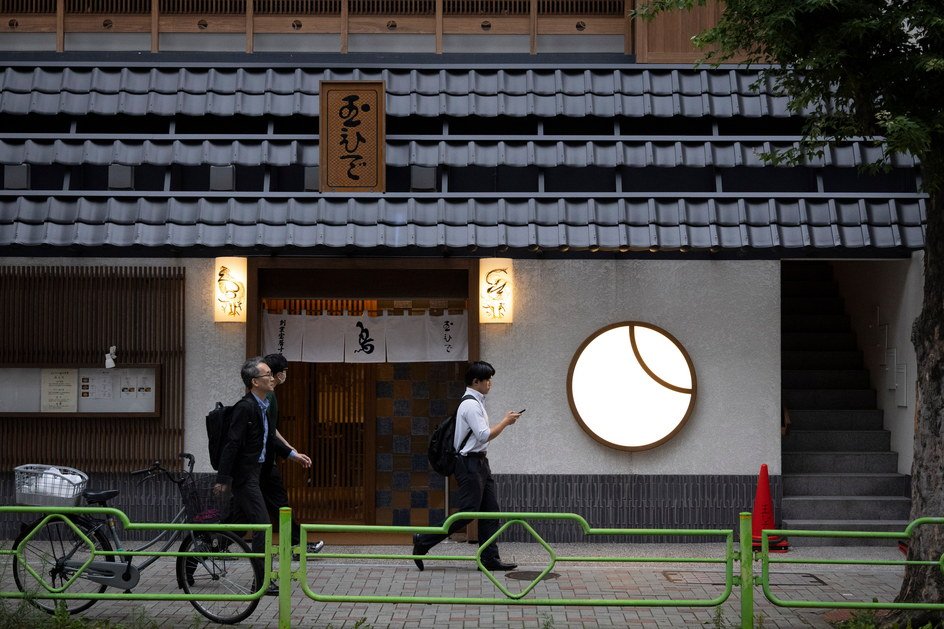
It was during this time that donburi meals, consisting of savory toppings heaped over a bowl of fresh, steamed rice, began to emerge. Five of them are considered to have originated in Tokyo, namely Gyudon, Katsudon, Tendon, Unadon, and Oyakodon. While various theories exist for the specific origin of most of these donburi, there is relatively little disagreement over the beginnings of Oyakodon, a meal consisting of savory chicken and egg over rice. In fact, visitors to Tokyo can experience a living part of the city’s culinary history by visiting the establishment believed to be its birthplace: the chicken restaurant Tamahide, founded in 1760.
Meiji-Period Gamecock Chicken
Tamahide is located in the small neighborhood of Ningyocho, nestled between Nihonbashi and the Sumida River. Like its neighbor, this has been part of Tokyo’s commercial heart since the Edo period (which began in 1603), when it was a destination for kabuki theatergoers. It also had many puppet shows and doll makers, leading to its name, which directly translates to “doll town.” Ningyocho’s small walkways and backstreets are still dotted with long-established shops and restaurants, some with histories spanning several centuries. Tamahide’s history is directly tied to the history and culture of Ningyocho. When the restaurant was founded in 1760, some of the area’s entertainments would be considered unsavory (pun intended) today: Tamahide originally specialized in shamo-nabe, a hot pot made with gamefowl chickens that were used for cockfighting.
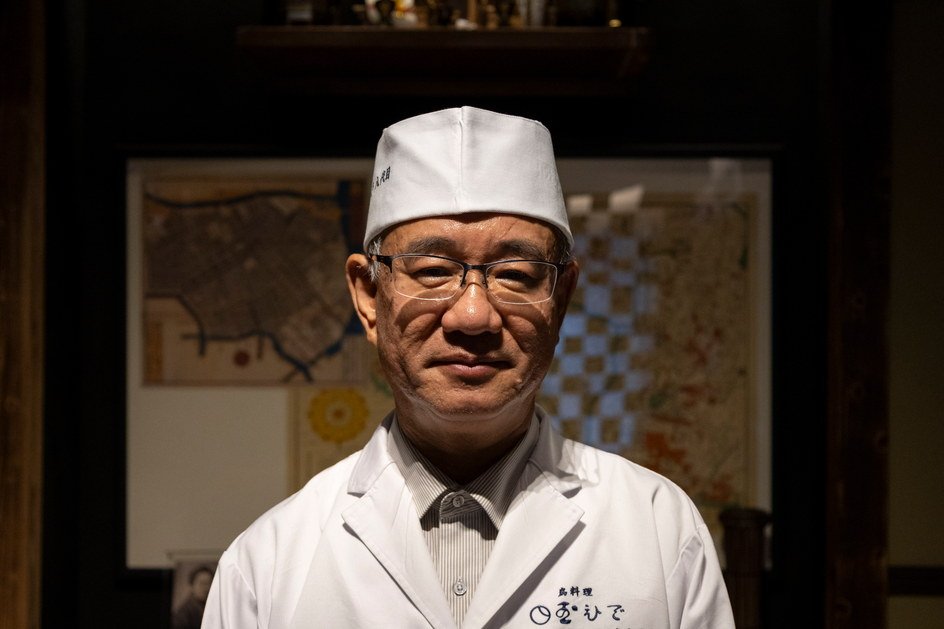
“Shamo-nabe,” said Konosuke Yamada, the eighth-generation and current owner of Tamahide, “can be considered a prototype of sukiyaki.” Yamada went on to explain that while sukiyaki is now usually associated with beef, shamo-nabe was enjoyed long before in Edo. Tamahide still uses shamo chicken in its oyakodon, although the animals are just raised for meat now and no longer engaged in combat.
The founder of Tamahide, Yamada’s five-times-great-grandfather, was a falconer who served the Edo shogunate. Because he had both the skills to prepare birds and, due to his high-ranking status as a falconer, was able to procure soy sauce and mirin—both valuable and hard-to-obtain ingredients at the time—he began offering shamo-nabe for feudal lords as an on-site catering service.
Oyakodon Began with Customer Innovation
But the oyakodon that we know today came about much later in the 19th century and was actually inspired by the behavior of Tamahide’s diners, who wanted a way to enhance the delicious warishita—the soup stock made with soy sauce and mirin rice wine—left in their bowls. “At the end of a shamo-nabe meal, customers would order raw eggs,” said Yamada, “and pour them beaten over the leftover meat and warishita in the pot, eating it with rice as oyakoni.” (Oyakoni being a side dish of eggs and chicken simmered in a broth.)
“Seeing this,” continued Yamada, “the wife of the owner came up with the idea of placing oyakoni on top of rice. That was the beginning of oyakodon, and from documents preserved at the restaurant, we know this took place in 1891.”
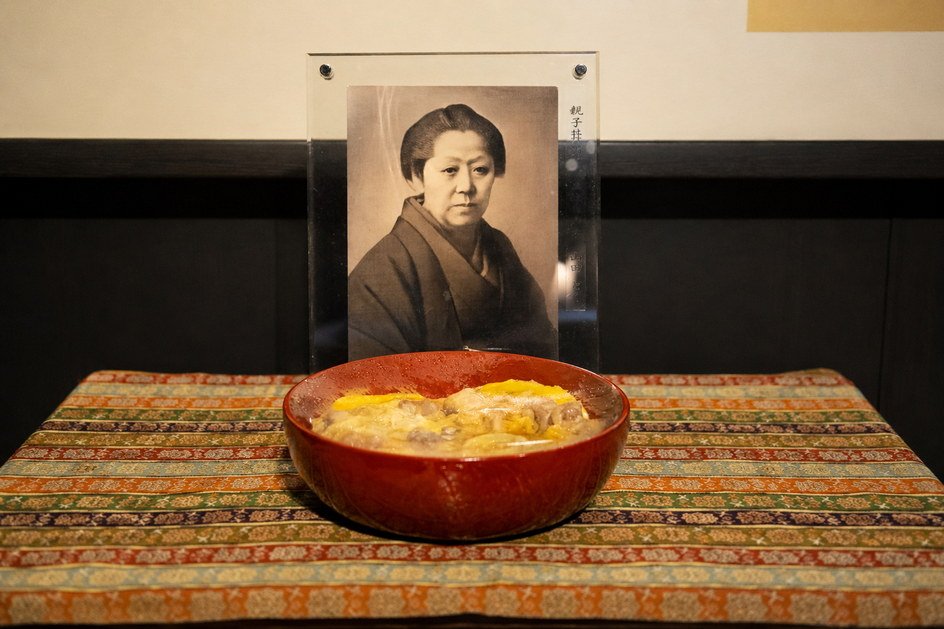
A stately photograph of Toku Yamada, who created the dish and was Yamada’s great-grandmother, is displayed inside Tamahide’s entrance hall. A fresh bowl of oyakodon is placed before it every day as an offering.
At the time of its creation, however, it seems that oyakodon was only offered as a delivery item and not on-site. “In Japan at the time, dishes of toppings and sauce poured over rice were not considered refined,” said Yamada. “To avoid lowering the status of the restaurant, oyakodon was available only for delivery. Nearby were the Nihonbashi fish market and the Tokyo Stock Exchange, and it seems oyakodon became popular as a dish people could quickly eat during short breaks from work.”
Today, oyakodon is often seen as an everyday dish, but at the time—despite its pedestrian status—shamo chicken and eggs were extremely valuable, with one bowl of oyakodon costing the equivalent of around 5,000 yen in today’s money. “The bowls were also expensive dishes, carved from wood and coated with lacquer, so delivery was limited to trusted, regular customers,” said Yamada. “I’ve heard from my ancestors that oyakodon was viewed as a kind of reward meal for work or business fortune.”
Tamahide is one of the Tokyo establishments that take pains to produce oyakodon the traditional way.
An Extra Egg Treatment for a Soft, Silky Texture
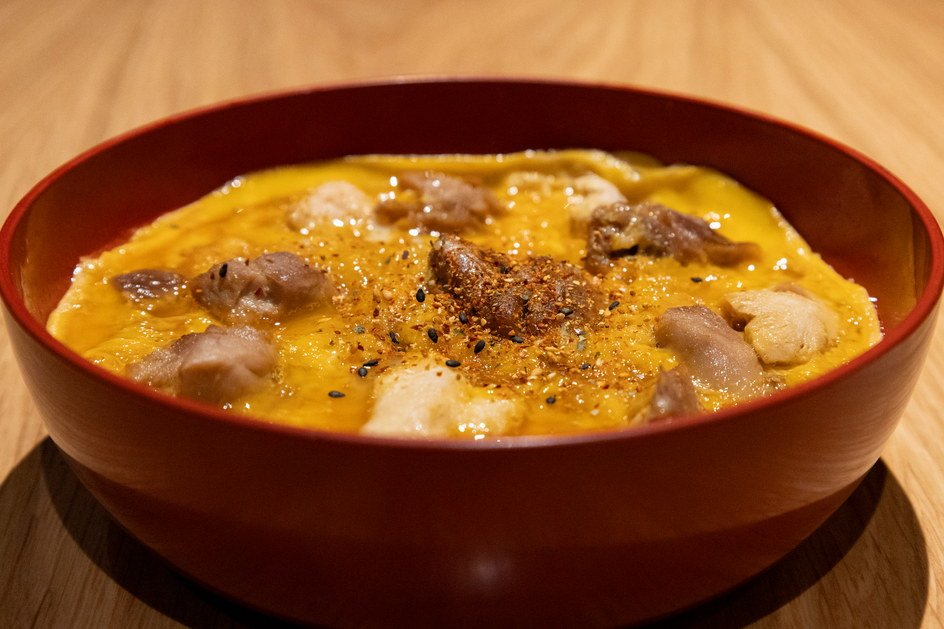
Oyakodon at Tamahide is prepared one serving at a time in a shallow, copper pan made specifically for the dish. The seasoning comes from a special warishita in which soy sauce and mirin are incorporated into an elegant broth made from kombu (kelp) and chicken stock.
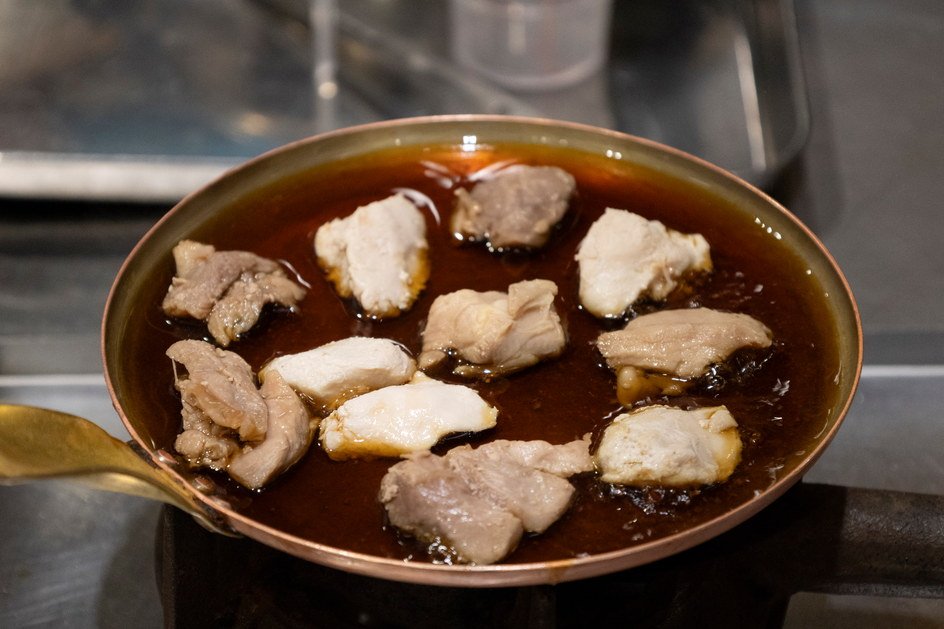
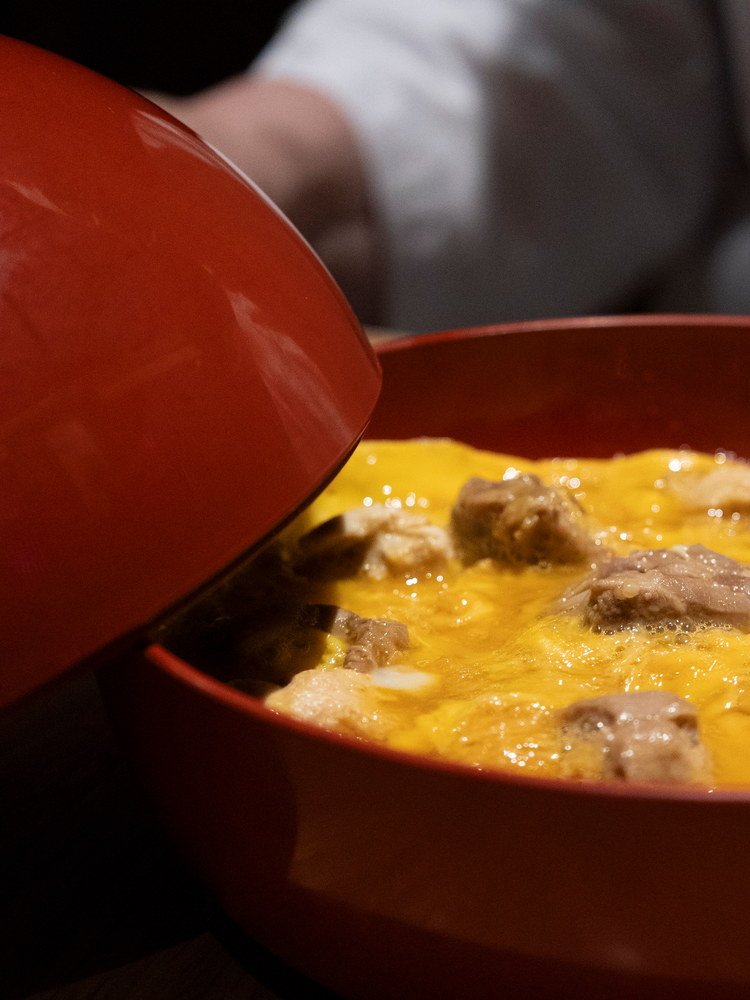
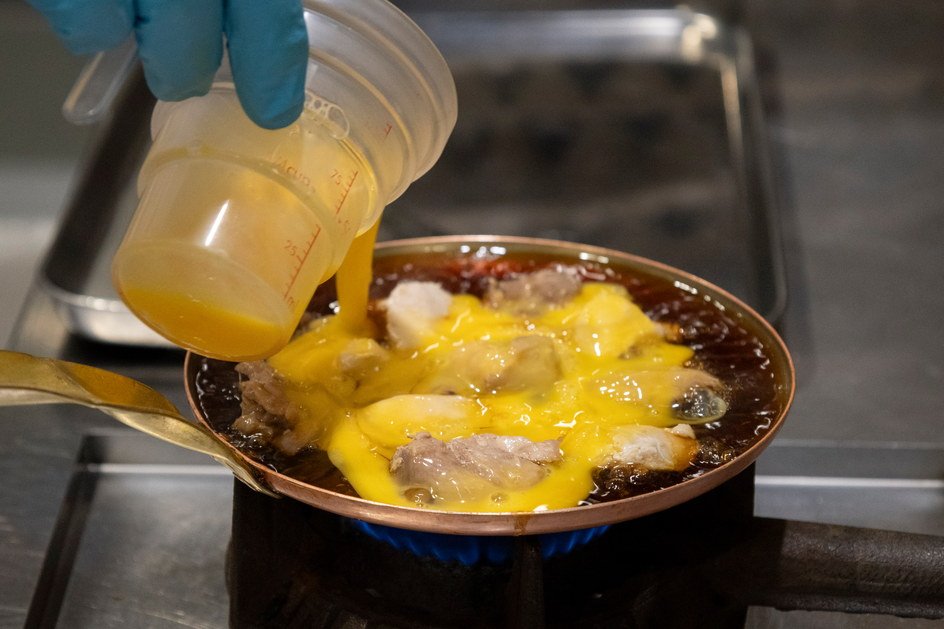
The warishita is poured into the pan, and pre-seasoned shamo thigh and breast meat, which have been cooked in an iron pot, are added in a ratio of 6:4. As the sauce heats up, the chef beats several eggs. Upon boiling, about half of the beaten egg is evenly poured over the top, and the mixture is cooked over medium heat for just under three minutes. As the egg layer begins to set, the remaining raw egg is added. Once this final spread of egg has warmed, the heat is turned off. The mixture is then deftly layered over a bed of rice in a donburi bowl, covered immediately with a lid, and carried to the waiting customer’s table.
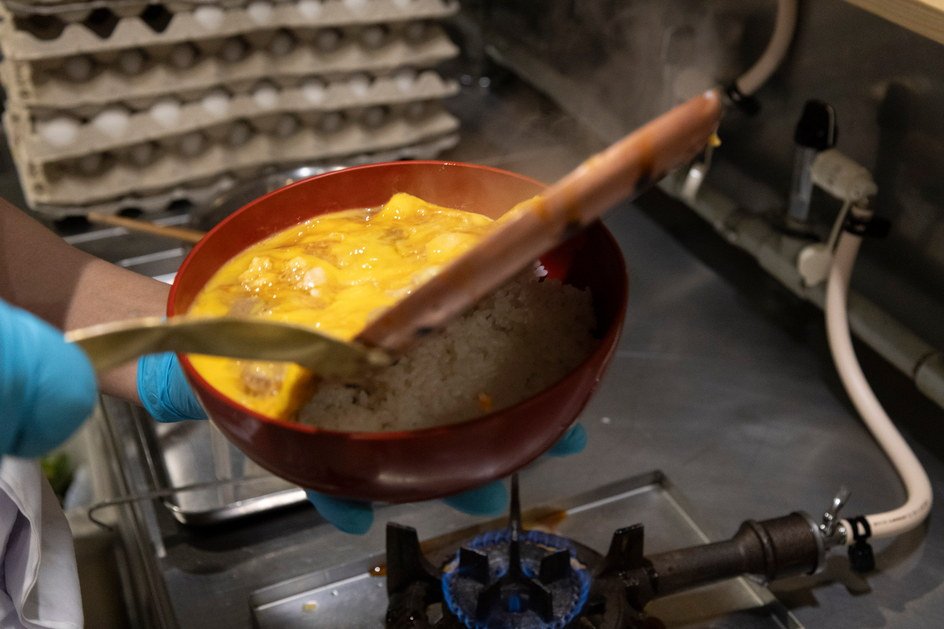
“We consider the time under the lid, when the dish is steamed by its own heat, to be part of the cooking process,” said Yamada. “It brings the ingredients and rice together, making the dish more delicious.”
When an oyakodon lid is opened, the trapped steam rises gently, whetting the diner’s appetite with its aroma and aesthetic. At Tamahide, a special spoon is served alongside the bowl so that even those who are not comfortable using chopsticks can easily enjoy the dish. When asked which utensil is most proper, Yamada emphatically said that it doesn’t matter. Oyakodon, however specially prepared, remains an everyday dish to be enjoyed informally. But like steeping tea, its nature evolves over time.
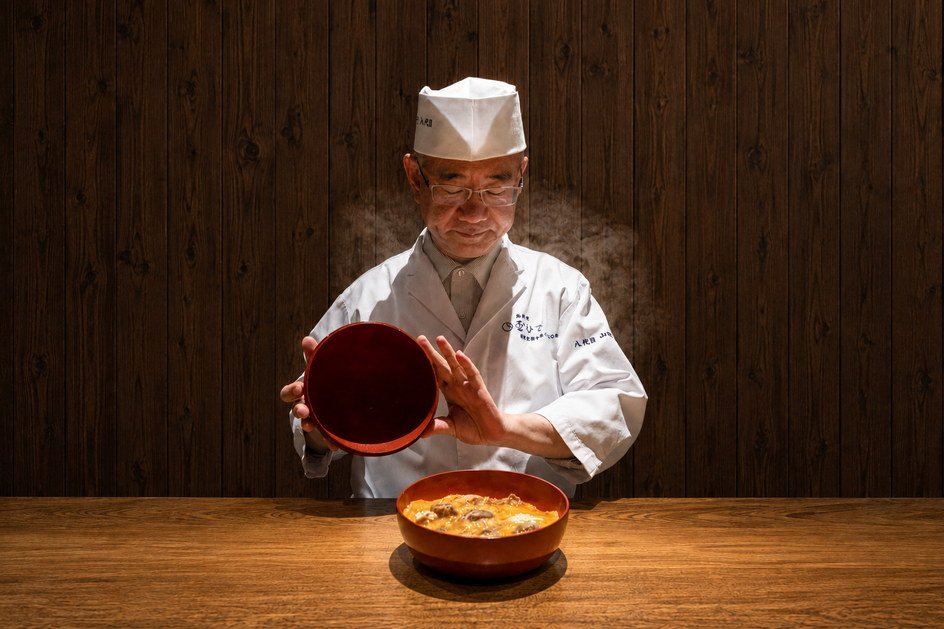
“Oyakodon’s egg changes little by little in color and flavor between the piping-hot moment it is made and the time it has rested slightly,” said Yamada. “When you eat it here, I hope you will enjoy it while it is hot.”
On the table, diners will find a special shichimi (seven spice) condiment that Tamahide developed to pair with its oyakodon, featuring black and sansho pepper (a traditional Japanese spice with a citrus aroma). One can sprinkle shichimi, which is also a traditional flavor of Edo, onto oyakodon according to taste and spice tolerance.
The Creation of a Special “Tokyo Shamo” Brand Chicken
Tamahide’s oyakodon is simple, with its main ingredients of shamo chicken, eggs, and rice. Its warishita contains soy sauce and mirin without added sugar in a throwback to the traditional Edomae (of the Edo period) flavor. The previous owner, Yamada’s father, placed great importance on preserving this traditional taste. “If I were told to make this myself,” said Yamada, who was quoting his father’s words, “I could probably make it a little tastier. But we can’t change the flavor. This is what it is, and I want people to eat it with this understanding.”
Although he has made a few tweaks to the seasoning which he felt had become too sweet and salty, to suit changing tastes, Yamada has continued to serve the dish in this traditional form. But with the rise of industrial-scale meat production, shamo-style chicken is increasingly hard to come by and Tamahide has made great efforts towards procurement over the last few decades.
“From around the mid-1960s, broiler chicken rearing (in which a particular breed of chicken is mass-produced) became widespread in Japanese poultry farming,” said Yamada. He went on to explain that there was a fear concerning the possible disappearance of traditionally raised poultry meat in Japan. “In oyakodon, the flavor of the meat directly affects the flavor of the dish, so unless Japan’s traditional native breeds, such as shamo, were revived, the taste could not be passed down.”
Yamada’s father began working with the Tokyo Metropolitan Livestock Experiment Station, now the Tokyo Metropolitan Agriculture and Forestry Research Center, to develop and promote the brand “Tokyo Shamo”, a revived, traditional shamo poultry. Yamada and Tamahide continue this work today. But despite the ongoing initiative, Yamada believes there is still room for improvement.
“Tokyo Shamo has a particularly firm texture among chickens distributed in Japan. Meat with well-developed muscle and a firm bite makes it easier to perceive umami [savoriness, one of the five basic tastes],” said Yamada. “It also cannot be too young; it must be raised for about 130 days to become delicious. We are now considering raising it for an even longer period.”
Shamo-style chicken, enjoyed at Tamahide and other traditional chicken or oyakodon establishments, truly does change the dish. Its somewhat gamey, chewy texture is arguably more interesting and delicious than the mass-produced, soft young chicken common in Japan and other developed countries, which is primarily optimized for an economical feed-to-product ratio. But it does take more effort to produce, and its continued existence is largely due to the dedication of Tamahide and other traditional Tokyo restaurants.
But Tamahide’s efforts don’t stop with poultry. The restaurant has also continued making requests to manufacturers regarding soy sauce and mirin, which are essential to the sweet-savory flavor of Edo. “The major soy sauce manufacturer we used relied on mass production and added antioxidants,” said Yamada. “I kept asking whether they could make soy sauce by the older methods, and eventually they began producing it that way as well. The same was true of our mirin manufacturer.” The flavor of Edo, in other words, rests not on the restaurant alone but on the makers who were willing to return to those traditional methods.
But while Tamahide continues to refine and protect the “traditional flavor of Edo”, this cannot be achieved by the restaurant’s efforts alone. Recognizing that the customers themselves play a part, Yamada said there is something he wants to ask of those who come to his restaurant.
“When several people visit, I would be happy if each person ordered a dish and enjoyed it to the end. Rather than coming only because ‘that restaurant always seems to have a line’ or ‘it seems famous,’ I would be happy if people also took an interest in this traditional Japanese style of seasoning and came to enjoy its flavors. The soft-set eggs and strong aroma of soy sauce may be a new experience for some people, but this is Tamahide’s traditional flavor.”
In the more than 130 years since Toku Yamada first spooned oyakoni over a bowl of rice, the dish has spread far beyond Ningyocho. Today oyakodon is served all over Tokyo — at long-established specialty shops, at neighborhood diners, and in department store restaurants — and tasting it at the counter where it began is one way into that history, and one of many doors into the food culture of the city.
Tokyo offers many other cuisines and a rich food culture — please explore them with GO TOKYO Gourmet.
Tamahide
Konosuke Yamada
Born in Tokyo on December 4, 1961, Yamada is the eldest son of the family behind Tamahide. He began helping at the restaurant while he was in junior high school and graduated from Hosei University in 1983. After training at Genyadana Hamadaya, a traditional Japanese restaurant in Ningyocho, he joined Tamahide and succeeded as its eighth-generation owner in 1998. While preserving the restaurant’s traditional flavors, he has also embraced new initiatives, including developing menus and setting prices in step with the times. He is dedicated both to preserving the culture of Nihonbashi Ningyocho, where he was born and raised, and to revitalizing the neighborhood.
Address
1-17-10 Nihonbashi Ningyocho, Chuo City, Tokyo 103-0013, Japan
http://www.tamahide.co.jp/
To learn more about
you can press “copy” and paste on search engine